This guide tells new clothing brands to test market demand before branding, legal procedures and production, and compares four manufacturing models for different budgets. It covers launch steps, common costly mistakes and recommends SuhuCustom factory for custom apparel production.
AI-generated summary
Most first-time clothing brand founders burn cash on a logo, an LLC, and a polished website before they have validated a single design with a real customer. The apparel market is saturated — generic styles fail, and doing things in the wrong order drains your budget before you learn what actually sells. This guide lays out the sequence that works: validate demand first, then handle legal and financial setup, then move into production and launch. It is written from the factory side, where we watch brands succeed and fail every season.
Quick Answer: The Right Order to Start a Clothing Brand
Start by validating your product idea with real customers. Then register your business and trademark. Then move into design, sampling, and production. Finally, build your sales channels and marketing engine. The table below summarizes the four business models you can choose, each with different cost, risk, and control trade-offs.
Business Model | Startup Cost | MOQ | Design Control | Profit Margin | Best For |
Print-on-Demand (POD) | Near zero | No minimum | Low — blank garments only | Low (15–25%) | Testing designs, zero-budget beginners |
CMT (Cut, Make, Trim) | Medium | Flexible | High — you supply fabric | Medium (30–45%) | Designers who know fabrics, small batches |
FPP (Full-Package Production) | High | Typically 50–1,000 pcs | Full — factory handles everything | High (40–60%) | Established brands scaling a collection |
Handmade / In-House | Medium-high | No minimum | 100% custom | Variable | Niche artisan brands, very small runs |
Rule of Thumb: If you have never sold a single garment, start with POD or a small CMT run. Move to FPP only after you have proven demand and can commit to minimum order quantities.
What It Means to Start a Clothing Brand
Starting a clothing brand means turning a design concept into a repeatable, sellable product — and it involves far more than making samples. You are choosing a business model, validating a niche audience, managing legal and financial infrastructure, sourcing materials or a factory partner, and building a marketing engine that makes people care. The brands that survive do all of this in the right sequence: product validation first, infrastructure second, production third, marketing integrated throughout. The brands that fail usually invert this order — they spend on branding and legal before they know anyone wants what they are selling.
How to Start a Clothing Brand
Step 1: Pick a Niche and Validate Demand Before Anything Else
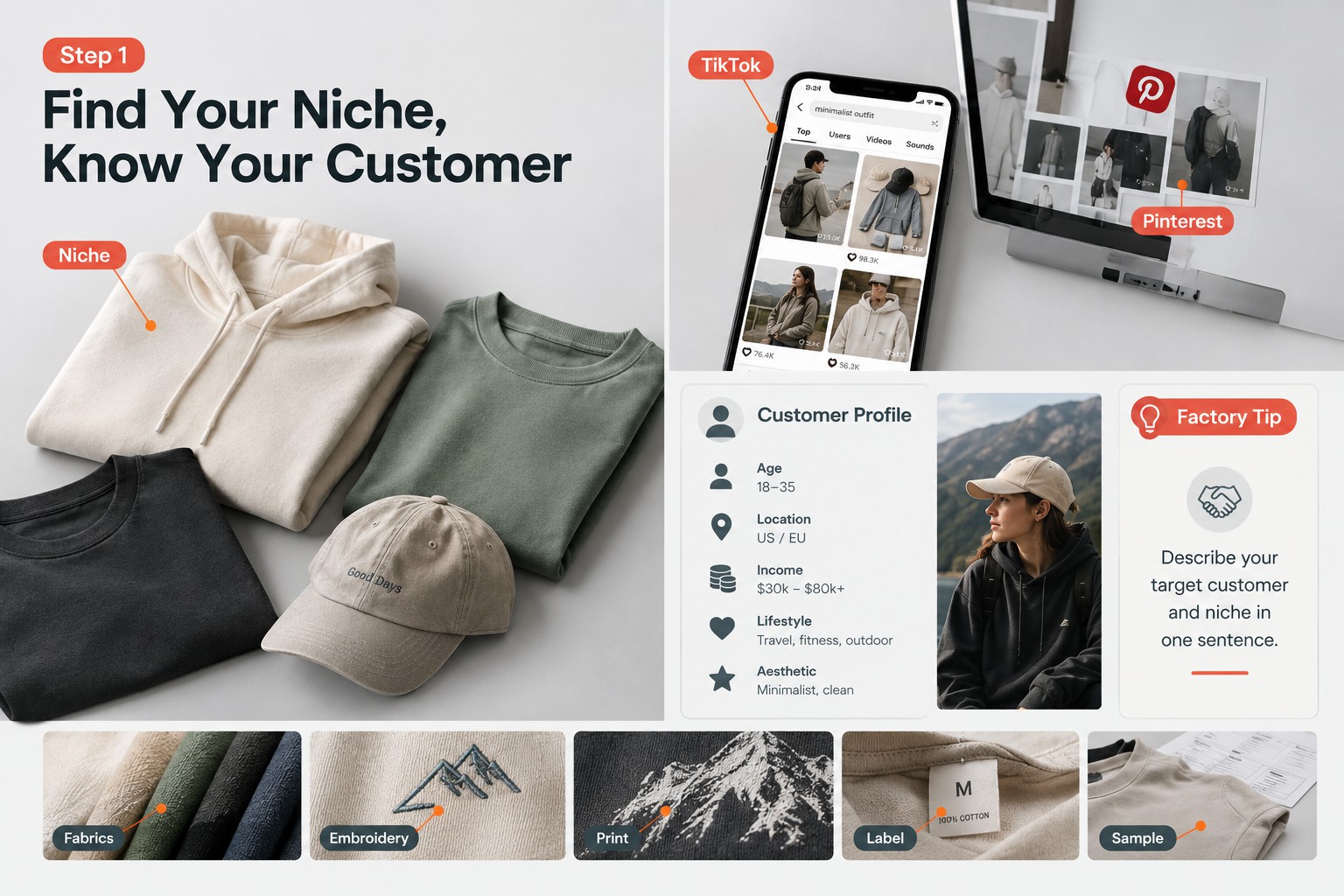
Niche selection is the single highest-leverage decision you will make — a focused sub-category (minimalist activewear, vintage streetwear, eco-friendly baby apparel, extended-size menswear) is far easier to launch and defend than a generic "lifestyle clothing" line. Research your target audience on TikTok, Pinterest, and competitor review sections to find people with a clear, unmet preference. Build a simple customer profile covering age, location, income, lifestyle, and aesthetic taste — this profile will guide every downstream decision from fabric weight to pricing.
Factory Tip: Do not approach a factory until you can describe your target customer in one sentence and your product niche in five words. Vague briefs produce vague samples and wasted sample fees.
Step 2: Choose Your Business Model
Your business model determines your startup capital, inventory risk, and how much control you have over fabric, fit, and finish. Print-on-Demand lets you test designs with zero inventory but locks you into blank-stock garments with limited customization. CMT (Cut, Make, Trim) gives you full fabric and pattern control but requires you to source materials yourself. FPP (Full-Package Production) is the most common path for scaling brands — the factory handles fabric sourcing, pattern-making, cutting, sewing, and decoration, typically with a 50–1,000 piece MOQ. Handmade production offers 100% originality but cannot scale beyond small runs.
Buyer Check: Match your model to your budget and experience level. Zero budget + no manufacturing experience = POD. Design skills + small budget = CMT. Validated product + capital + growth plan = FPP.
Step 3: Create Your Designs and Build a Tech Pack
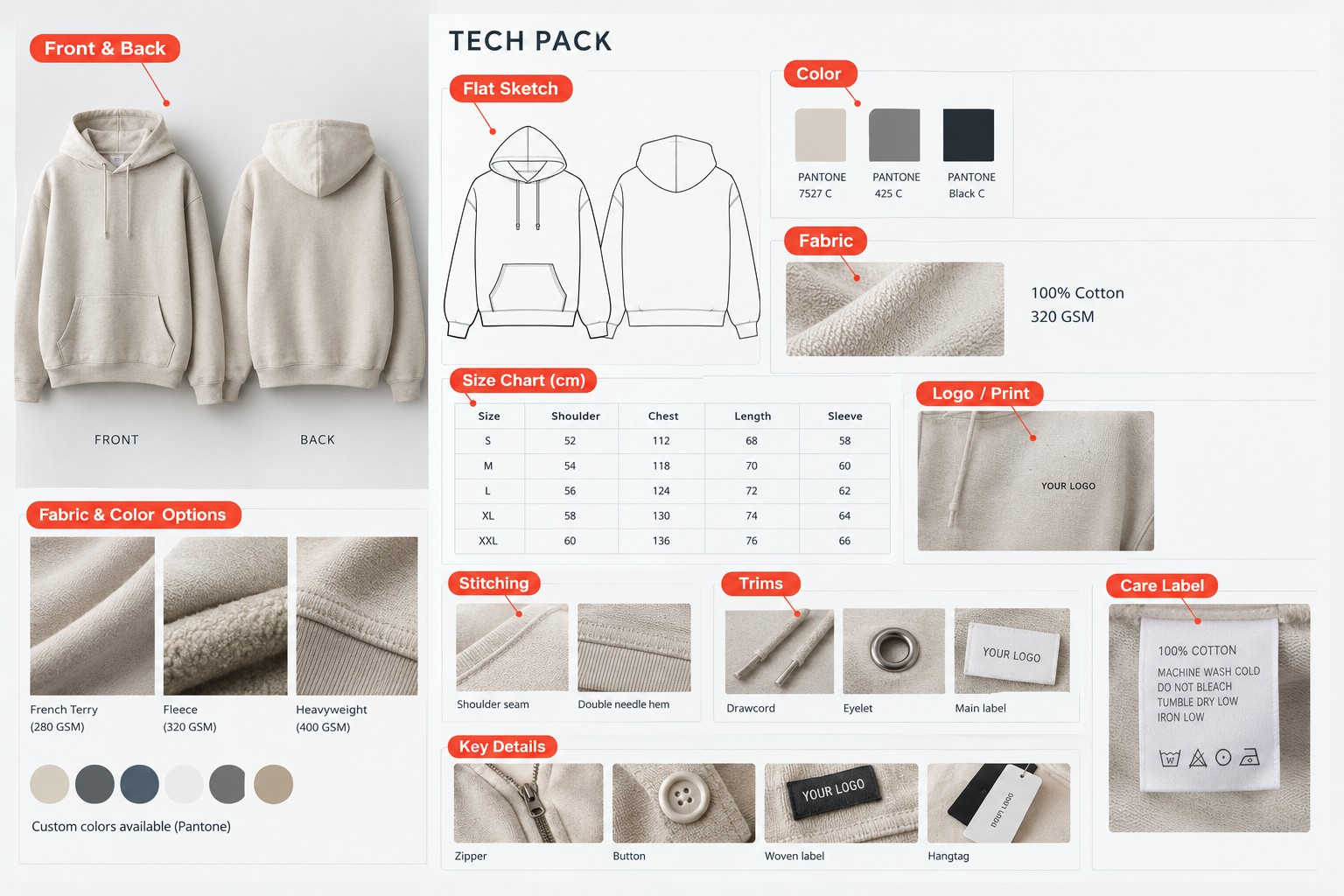
A tech pack is the technical blueprint that tells a factory exactly how to construct your garment. Without one, factories cannot quote accurately, and every sample round becomes a guessing game that costs time and money. A complete tech pack includes front and back flat sketches, a detailed size chart with measurements, fabric composition and weight (GSM), Pantone color codes, logo or print placement, stitching requirements, trim details (zippers, buttons, labels), and wash care label text.
Rule of Thumb: A complete tech pack reduces sample revision rounds by 50% or more. Missing specs — especially fabric weight and color codes — are the leading cause of delayed and inaccurate samples.
Step 4: Develop Samples and Iterate
Sampling happens in layers: a prototype sample (to test fit and construction), a sales sample (for marketing and pre-orders), and a pre-production confirmation sample (the final approved version before bulk). Each round typically takes 3–7 days depending on product complexity and fabric availability, and each round carries a sample fee. Budget for at least two to three rounds — first samples rarely match the final vision, and iteration is where the product gets refined.
Factory Tip: Provide consolidated, written feedback after each sample round. Verbal or scattered feedback across messages leads to miscommunication and repeat errors that extend the timeline.
Step 5: Set Up Your Legal and Financial Foundation
Once your product is validated, register your business entity and protect your intellectual property. For most US-based founders, an LLC (Limited Liability Company) is the standard choice — it separates personal assets from business liabilities, lets you open a business bank account, and is required by most factories for production contracts. Apply for an EIN (Employer Identification Number) through the IRS at no cost. Trademark your brand name and logo through the USPTO — this protects against copycats and is essential before you invest in marketing and inventory.
Legal Item | When to Do It | Why It Matters |
Business entity (LLC) | After product validation, before factory contracts | Separates personal assets from business debt |
EIN (tax ID) | Immediately after LLC registration | Required for business banking and contracts |
Trademark (USPTO) | Before scaling marketing and inventory | Prevents brand name and logo theft |
Import documentation | Before first overseas shipment | Commercial invoice, fabric composition, HS codes required for customs clearance |
Keep financial records from day one — bank statements, purchase receipts, platform fees, and sales records. The IRS considers an activity a business (not a hobby) if it is profitable in 3 of 5 consecutive years, and proper documentation is essential for tax filing and potential audits.
Step 6: Find and Vet a Manufacturing Partner
Finding the right factory is about matching your order size, product type, and quality expectations to a partner who can deliver consistently. Source manufacturers through industry trade shows, online sourcing platforms, and direct factory outreach. Before signing any production agreement, compare at least three factories on these criteria:
MOQ flexibility — Can they accommodate your order size, and is there room to grow?
Sample timeline — How long does sampling take, and what are the sample fees?
Unit pricing — Is the quote all-inclusive (fabric, cutting, sewing, decoration, packaging)?
Communication quality — Do they respond clearly and promptly? Vague or evasive answers signal future problems.
Quality control process — Do they conduct fabric inspection, color consistency checks, shrinkage testing, and a final pre-shipment inspection?
Red Flags: A factory that refuses to send samples, cannot provide a clear production timeline, quotes prices far below market rate, or cannot specify their QC process is a risk to your brand and your cash flow.
Step 7: Build Your Brand Identity
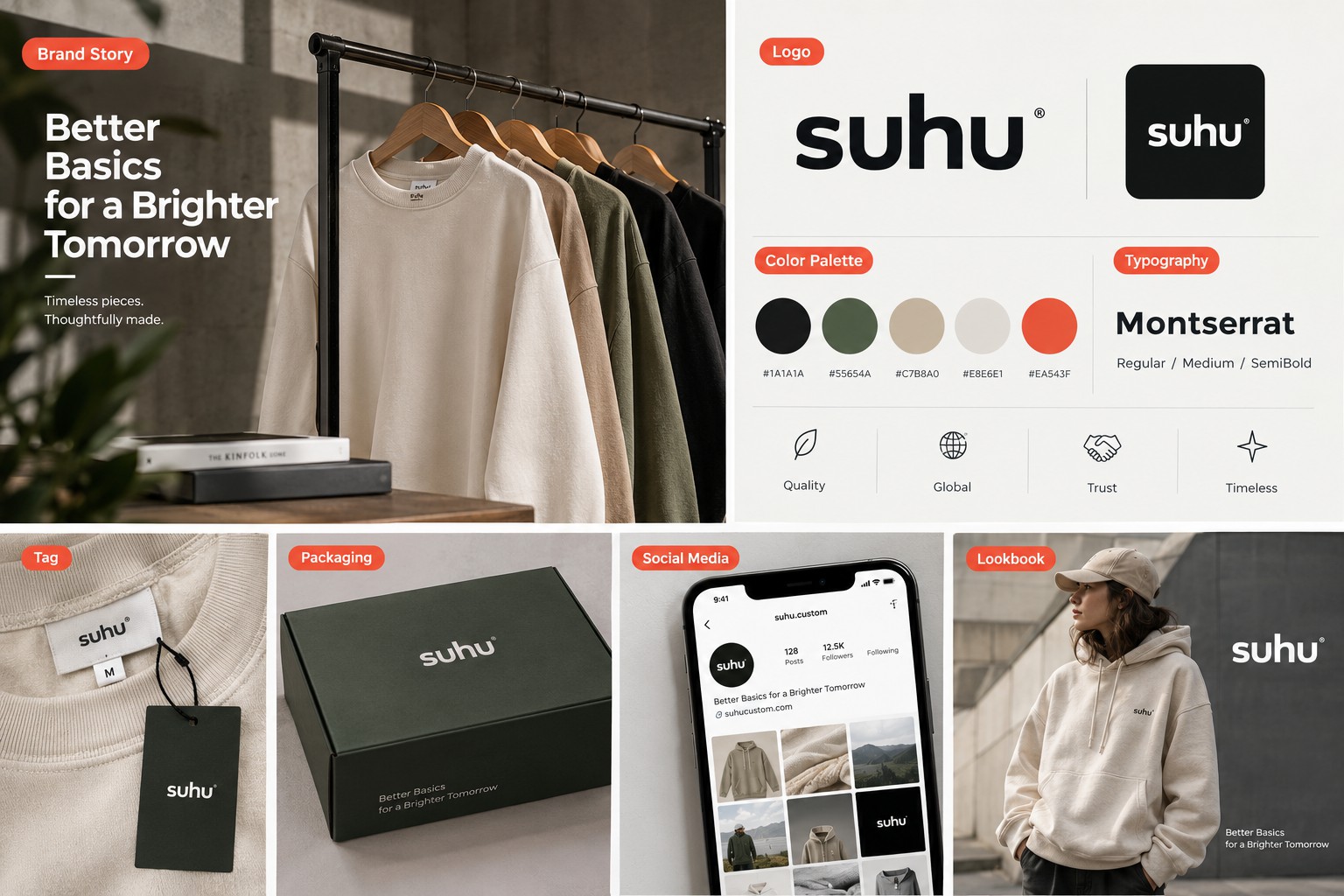
Your brand identity is what makes people choose your product over a competitor's — in apparel, customers buy identity and lifestyle, not fabric. Three elements form the foundation: a brand name (check trademark and domain availability), a brand story or core value (what makes you different — sustainable fabrics, subcultural belonging, inclusive sizing), and a consistent visual system (logo, color palette, typography applied uniformly across website, packaging, and social media).
Rule of Thumb: You can build a serviceable brand identity with free design tools in the early stage. Invest in professional design only after your product has traction — overspending on branding before validation is a top-three budget drain for new founders.
Step 8: Set Up Your Sales Channels
Most new clothing brands sell through a combination of an independent e-commerce store and online marketplaces. An independent store (built on an e-commerce platform) gives you full brand control, customer data, and integration with marketing tools and inventory systems. Marketplaces provide existing traffic but charge fees, limit branding, and pit you against direct competitors on the same page.
Essential store configurations: a custom domain with a professional email address (not a free Gmail address), high-resolution product photos showing real fit and fabric detail (mockup-only listings drive up return rates), complete product descriptions with fabric composition and size charts, and a mobile-optimized layout — over half of apparel traffic comes from phones, and page load speed affects both conversion and search ranking.
Step 9: Launch With Marketing and Community Building
Marketing is not a post-launch task — it should begin during product development. The core logic of apparel marketing is that customers buy identity, not utility, so your content should communicate the lifestyle and values your brand represents. Prioritize short-form video (behind-the-scenes production, styling tutorials, brand story), community building in niche groups and email lists, and collaborations with micro-influencers and local creators who share your audience.
Factory Tip: The brands we see succeed long-term treat their first 100 customers as a community, not a sales target. Repeat customers cost far less to acquire than new ones, and a loyal base provides stable cash flow that funds growth.
Common Mistakes When Starting a Clothing Brand
1. Over-investing in visuals before validating demand. Spending heavily on a logo, website, and professional photography before testing whether anyone wants your product is the fastest way to burn startup capital. Avoid it by validating with simple prototypes and real customer feedback first.
2. Treating marketing as an afterthought. Producing a full inventory run with no marketing plan leads to unsold stock and cash flow collapse. Allocate marketing budget and content strategy from day one — even a POD test run needs social media seeding to generate orders.
3. Launching too many SKUs at once. Starting with multiple styles in multiple colors multiplies your production, inventory, and operational complexity exponentially. Start with a 1–5 piece capsule collection, prove the concept, then expand.
4. Underestimating hidden costs. Sample fees, international freight, import duties, return processing, and deadstock write-downs are rarely included in initial cost projections. Build a cost model that includes these line items before committing to bulk production.
5. Skipping the tech pack. Approaching a factory without a tech pack leads to inaccurate quotes, repeated sample revisions, and delayed timelines. A complete tech pack is the single most effective cost-control tool in apparel production.
6. Ignoring trademark registration. Launching under an unregistered name leaves your brand exposed to copycats and potential forced rebranding. Run a USPTO search before committing to a name, and file the trademark before scaling.
7. No standardized operations system. When orders spike, manual processes break — wrong shipments, delayed fulfillment, and customer service collapse. Set up order management, inventory tracking, and shipping automation before you need them, not after.
How SuhuCustom Supports Your Brand Launch
SuhuCustom is a source apparel factory based in Humen, Dongguan, China — one of the largest garment manufacturing hubs in the world. If you are on the FPP or CMT path, SuhuCustom provides OEM/ODM custom apparel manufacturing across hoodies, T-shirts, knitted hats, sports socks, corporate uniforms, workwear, team apparel, and private-label products.
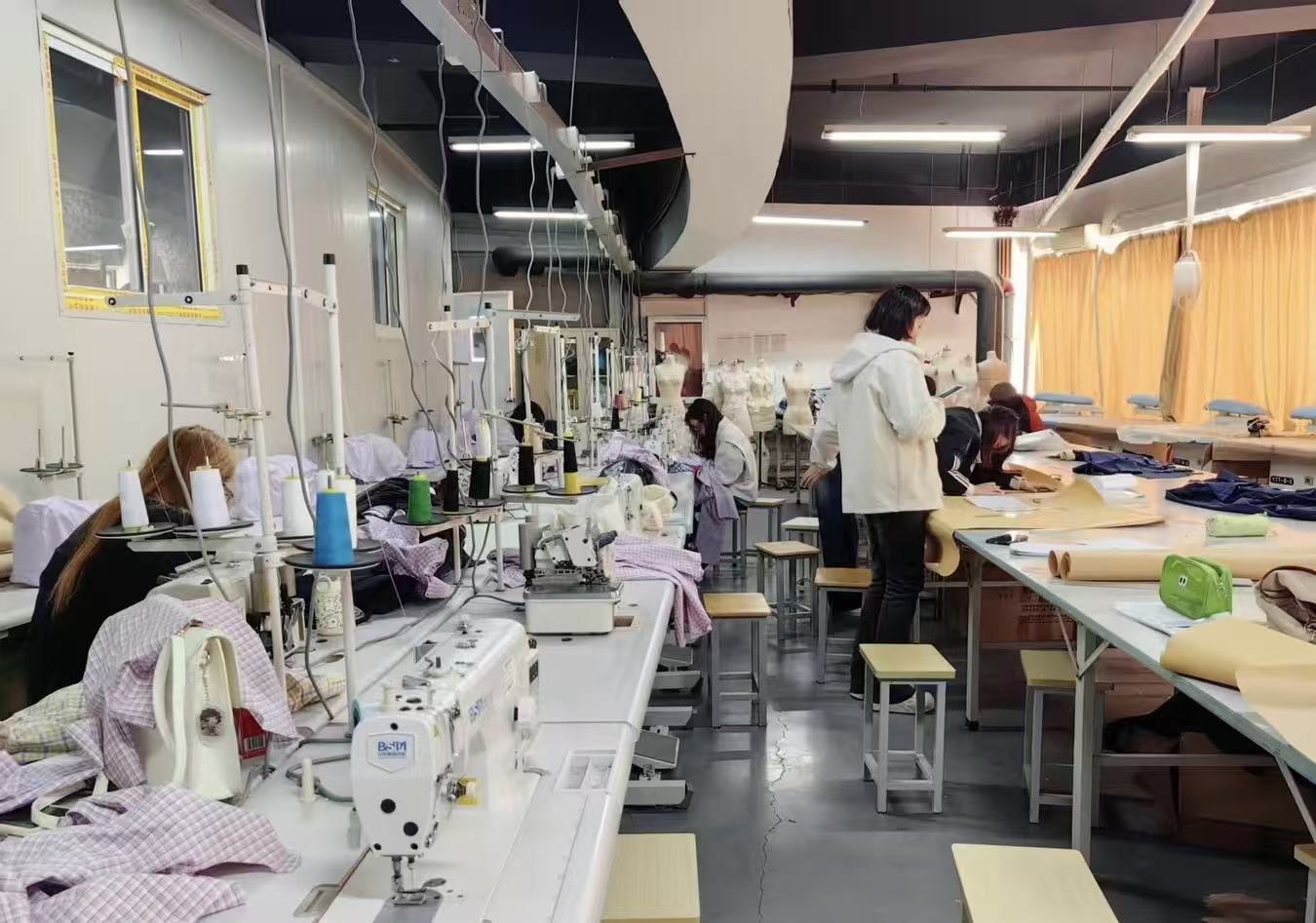
What this means for a new brand founder:
Factory-direct pricing with no trading-company markup — you communicate directly with the production team, not an intermediary.
Flexible MOQ that accommodates small-batch trial orders, so you can test a product line without committing to large volumes upfront.
Sample development usually taking 3–7 days, depending on product complexity and fabric availability.
Full decoration capabilities — logo embroidery, screen printing, digital printing, and heat transfer — so you can select the right logo method for each product without sourcing multiple vendors.
Quality control checkpoints including fabric inspection, color consistency verification, shrinkage control, and a final pre-shipment inspection before goods leave the factory.
Export order support with one-to-one follow-up, design confidentiality agreements, and video factory inspection — so you can verify your production partner without an international trip.
SuhuCustom fits naturally into the FPP and CMT paths described in this guide. If your business model is POD-only, you may not need a factory partner yet — but when you are ready to move beyond blank-stock garments and into custom cut-and-sew production, a direct factory relationship gives you better pricing, more design control, and a clearer quality assurance process.
Conclusion
Starting a clothing brand is a sequence of decisions — niche, model, design, legal, production, launch — and getting the order right saves you time, money, and frustration. If you are ready to move beyond POD and into custom cut-and-sew production, the next step is finding a factory partner who can turn your tech pack into a real, wearable product.
SuhuCustom offers factory-direct OEM/ODM manufacturing with flexible MOQ, sample development in 3–7 days, full decoration capabilities, and one-to-one export support. Send us your tech pack or design concept, and we will provide a detailed quote and sampling plan.