Dress Size Chart: The Complete Guide to Measurements, Fit Types & International Conversions
Dress sizing starts with bust, waist, and hip measurements mapped to US numeric sizes 0–18. When measurements fall across sizes, pick the size that fits your largest measurement.
AI-generated summary
Getting dress sizing right is one of the most consequential decisions for any apparel brand. A mismatch between your size chart and your customers' actual body measurements leads to returns, negative reviews, and lost revenue -- often before the product even gets a fair wear-test. This guide covers the core measurement methods, standard US and UK numeric size charts, international conversion tables, letter-size ranges by brand and category, dress length categories, silhouette and fit classifications, and the practical steps for building a size chart that works for your brand from the factory floor up.
Quick Reference: US Standard Numeric Dress Sizes (Body Measurements, Inches)
| US Size | Bust | Waist | Hip |
|---|---|---|---|
| 0 | 32" | 26" | 36" |
| 2 | 33" | 27" | 37" |
| 4 | 34" | 28" | 38" |
| 6 | 35" | 29" | 39" |
| 8 | 36" | 30" | 40" |
| 10 | 37" | 31" | 41" |
| 12 | 38.5" | 32.5" | 42.5" |
| 14 | 40" | 34" | 44" |
| 16 | 42" | 36" | 46" |
| 18 | 44" | 38" | 48" |
Rule of Thumb: When your bust, waist, and hip measurements fall into three different sizes, choose the size that matches your largest measurement and plan for minor alterations where the garment runs loose.
How to Measure for a Dress
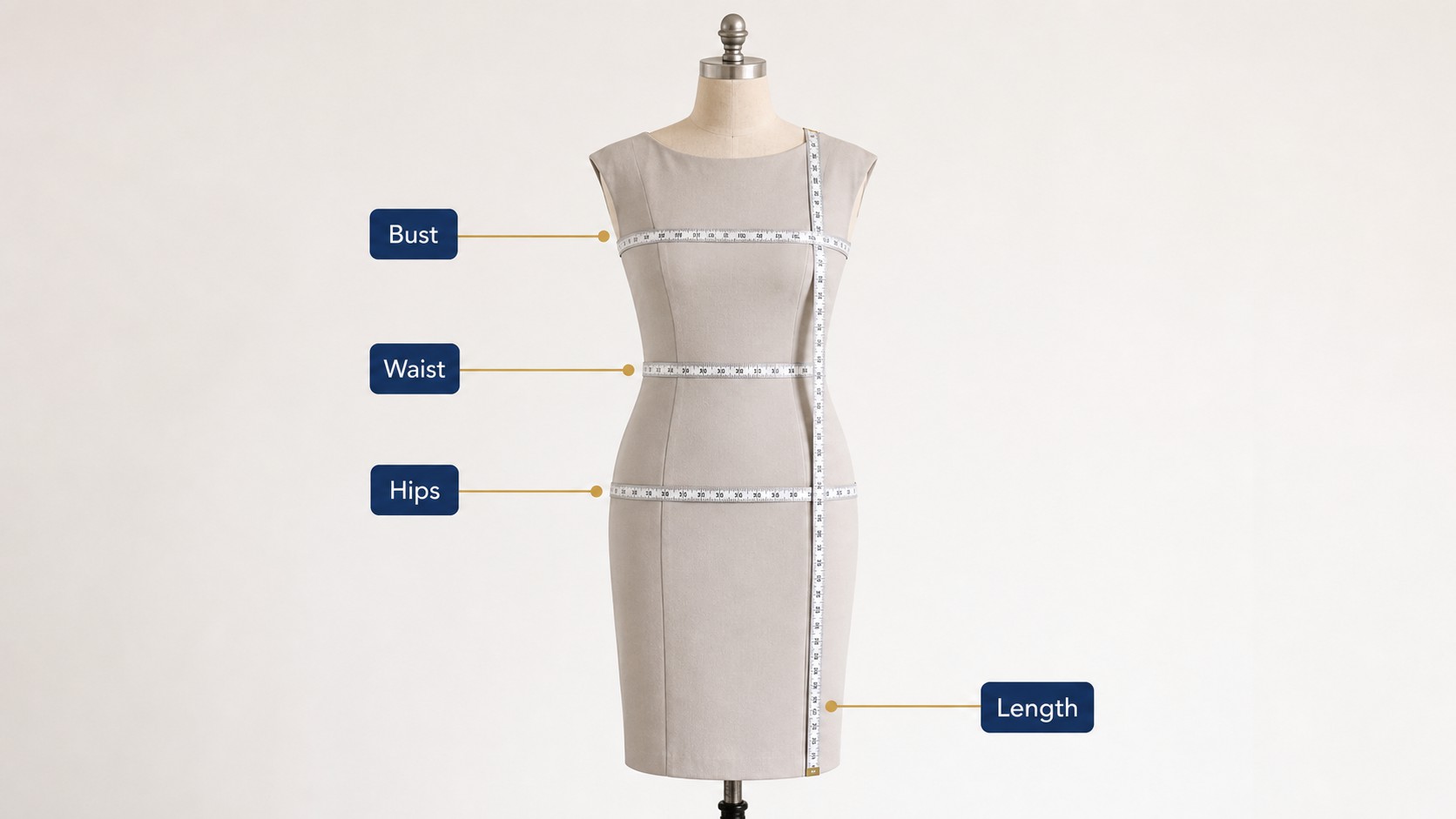
1. Measure your bust at the fullest point.
Wrap a soft tape measure around the fullest part of your chest, keeping the tape level across your back and slightly loose -- not pulled tight. Wear your everyday undergarments during this measurement, as bra fit changes bust circumference by an inch or more. Record the number in both inches and centimeters; most international size charts use at least one of these units.
2. Measure your waist at the narrowest natural indent.
Stand upright and bend slightly sideways to locate the narrowest point of your torso -- usually just above the belly button. Wrap the tape horizontally around this indent without compressing the skin. This measurement is the foundation for any waist-defined silhouette (Fit Flare, A-Line with a seamed waist).
3. Measure your hips at the widest point below the waistline.
Stand with feet together and wrap the tape around the widest part of your hips and buttocks, typically 7-9 inches (about 20 cm) below your natural waist. This measurement is critical for any dress with a fitted hip section -- Bodycon and Fit Flare styles in particular.
Factory Tip: When supplying body measurements to a factory for custom dress production, provide all three measurements (bust, waist, hip) in both inches and centimeters. Inconsistent units between your tech pack and the factory's internal standard cause grading errors.
US Standard Dress Size Chart (Numeric 0-18)
The US numeric system is the most widely referenced dress sizing standard in North America. Sizes run from 0 to 18, with bust measurements spanning 32" to 44" and each size adding approximately 1 inch to the bust measurement through size 10, then 1.5 inches per size above 10.
| US Size | Bust (in) | Bust (cm) | Waist (in) | Waist (cm) | Hip (in) | Hip (cm) |
|---|---|---|---|---|---|---|
| 0 | 32 | 81 | 26 | 66 | 36 | 91 |
| 2 | 33 | 83.5 | 27 | 68.5 | 37 | 94 |
| 4 | 34 | 86 | 28 | 71 | 38 | 96.5 |
| 6 | 35 | 89 | 29 | 73.5 | 39 | 99 |
| 8 | 36 | 91 | 30 | 76 | 40 | 101.5 |
| 10 | 37 | 94 | 31 | 78.5 | 41 | 104 |
| 12 | 38.5 | 97 | 32.5 | 82 | 42.5 | 108 |
| 14 | 40 | 101.5 | 34 | 86 | 44 | 112 |
| 16 | 42 | 106.5 | 36 | 91 | 46 | 117 |
| 18 | 44 | 111 | 38 | 96 | 48 | 122 |
Buyer Check: The US chart above represents body measurements, not garment measurements. Garment measurements include ease -- typically 1-2 inches at the bust for a slim-fit dress, 3-4 inches for relaxed-fit. Always specify "body" vs. "garment" measurements in your tech pack to avoid production confusion.
UK Dress Size Chart (Standard, Petite, Curve and Tall)
UK dress sizes run two numbers higher than US sizes -- a UK 10 equals a US 6. The UK system also includes dedicated sub-ranges: Petite (for heights up to 5ft 3in / 160 cm), Curve/Plus (UK 18-30), Maternity (same day-size numbers, wider bust and hip allowances), and Tall (same circumference, longer torso and leg proportions).
ASOS Standard UK Sizes (Inches / Centimeters)
| UK Size | Bust | Waist | Hip |
|---|---|---|---|
| 4 | 31" / 78 cm | 24" / 60 cm | 33" / 83.5 cm |
| 6 | 32" / 80.5 cm | 25" / 62.5 cm | 34" / 86 cm |
| 8 | 33" / 83 cm | 26" / 65 cm | 35" / 88.5 cm |
| 10 | 35" / 88 cm | 28" / 70 cm | 37" / 93.5 cm |
| 12 | 37" / 93 cm | 30" / 75 cm | 39" / 98.5 cm |
| 14 | 39" / 98 cm | 31" / 80 cm | 41" / 103.5 cm |
| 16 | 41" / 103 cm | 33" / 85 cm | 43" / 108.5 cm |
| 18 | 44" / 110.5 cm | 36" / 92.5 cm | 46" / 116 cm |
ASOS Petite Sizes (Up to 5ft 3in / 160 cm)
Petite sizing adjusts body proportions for shorter frames -- slightly narrower bust and hip measurements, shorter torso length, and shorter hem lengths compared to the standard range.
| UK Size | Bust | Waist | Hip |
|---|---|---|---|
| 2 | 29" / 73.5 cm | 22" / 55.5 cm | 31" / 80 cm |
| 4 | 30" / 76 cm | 23" / 58 cm | 32" / 82.5 cm |
| 6 | 31" / 78.5 cm | 24" / 60.5 cm | 33" / 85 cm |
| 8 | 32" / 81 cm | 25" / 63 cm | 34" / 87.5 cm |
| 10 | 34" / 86 cm | 27" / 68 cm | 36" / 92.5 cm |
| 12 | 36" / 91 cm | 29" / 73 cm | 38" / 97.5 cm |
| 14 | 38" / 96 cm | 31" / 78 cm | 40" / 102.5 cm |
| 16 | 40" / 101 cm | 33" / 83 cm | 42" / 107.5 cm |
ASOS Curve / Plus Sizes (UK 18-30)
| UK Size | Bust | Waist | Hip |
|---|---|---|---|
| 18 | 43" / 109 cm | 36" / 91 cm | 46" / 116.5 cm |
| 20 | 46" / 116 cm | 39" / 98 cm | 49" / 123.5 cm |
| 22 | 48" / 123 cm | 41" / 105 cm | 51" / 130.5 cm |
| 24 | 51" / 130 cm | 44" / 112 cm | 54" / 137.5 cm |
| 26 | 54" / 137 cm | 47" / 119 cm | 57" / 144.5 cm |
| 28 | 57" / 144 cm | 50" / 126 cm | 60" / 151.5 cm |
| 30 | 59" / 151 cm | 52" / 133 cm | 62" / 158.5 cm |
ASOS Maternity Sizes
Maternity sizing uses the same UK day-size numbers as regular sizing, but bust and hip measurements include built-in room for a growing belly. Select your pre-pregnancy UK size and the dress pattern accounts for the extra circumference.
| UK Size | Bust | Waist (Low) | Low Hip |
|---|---|---|---|
| 4 | 32" / 81 cm | 35" / 90 cm | 33" / 84 cm |
| 6 | 33" / 83.5 cm | 36" / 92.5 cm | 34" / 86.5 cm |
| 8 | 34" / 86 cm | 37" / 95 cm | 35" / 89 cm |
| 10 | 36" / 91 cm | 39" / 100 cm | 37" / 94 cm |
| 12 | 38" / 96 cm | 41" / 105 cm | 39" / 99 cm |
| 14 | 40" / 101 cm | 43" / 110 cm | 41" / 104 cm |
| 16 | 42" / 106 cm | 45" / 115 cm | 43" / 109 cm |
| 18 | 45" / 113.5 cm | 48" / 122.5 cm | 46" / 116.5 cm |
| 20 | 48" / 121 cm | 51" / 130 cm | 49" / 124 cm |
| 22 | 51" / 128.5 cm | 54" / 137.5 cm | 52" / 131.5 cm |
Rule of Thumb: If your brand sells into the UK market, start from the ASOS standard chart as your base, then add Petite, Curve, and Tall sub-ranges as your product line expands. Each sub-range requires its own fit sample to validate proportions.
International Dress Size Conversion Chart
International dress size conversions follow a fixed mapping: UK 10 = US 6 = EU 38 = IT 42 = AU 10. Russian sizing follows its own pattern and does not map linearly to the others. Use the table below as a quick cross-reference when you need to label the same garment for multiple markets.
| UK | US | EU | IT | AU | RU |
|---|---|---|---|---|---|
| 2 | 00 | 30 | 34 | 2 | 36/38 |
| 4 | 0 | 32 | 36 | 4 | 38 |
| 6 | 2 | 34 | 38 | 6 | 38/40 |
| 8 | 4 | 36 | 40 | 8 | 40 |
| 10 | 6 | 38 | 42 | 10 | 42/44 |
| 12 | 8 | 40 | 44 | 12 | 46 |
| 14 | 10 | 42 | 46 | 14 | 48 |
| 16 | 12 | 44 | 48 | 16 | 50 |
| 18 | 14 | 46 | 50 | 18 | 54 |
| 20 | 16 | 48 | 52 | 20 | 58 |
| 22 | 18 | 50 | 54 | 22 | 60/62 |
| 24 | 20 | 52 | 56 | 24 | 64 |
| 26 | 22 | 54 | 58 | 26 | 66/68 |
| 28 | 24 | 56 | 60 | 28 | 70 |
| 30 | 26 | 58 | 62 | 30 | 72/74 |
Buyer Check: EU and IT sizes are not identical despite both being "European." Italian sizes run 4 numbers higher than the EU equivalent -- EU 38 equals IT 42. Confirm which "European" convention your retailer expects before labeling.
Letter Size Chart (XXS-4XL)
Letter sizes (XXS through 4XL) map to numeric size ranges but vary significantly between brands and categories. An XL at one brand may measure a 40-inch bust while at another it measures 46 inches. The tables below show representative ranges across three common use cases: casual/relaxed fit, formal/evening wear, and general apparel.
Casual and Relaxed Fit (Garment Measurements)
Casual and relaxed-fit dresses have more ease built into the garment measurement than the body measurement. The numbers below represent garment bust circumference, not body bust.
| Letter Size | Numeric Range | Garment Bust | Garment Waist |
|---|---|---|---|
| XXS | 4-6 | 35" / 89 cm | 27" / 69 cm |
| XS | 6-8 | 37" / 94 cm | 29" / 74 cm |
| S | 8-10 | 39" / 99 cm | 31" / 79 cm |
| M | 10-12 | 41" / 104 cm | 33" / 84 cm |
| L | 14-16 | 43" / 109 cm | 35" / 89 cm |
| XL | 18-20 | 46" / 117 cm | 38" / 97 cm |
| XXL | 22-24 | 50" / 127 cm | 42" / 107 cm |
| 3X | 26-28 | 54" / 137 cm | 46" / 117 cm |
| 4X | 30-32 | 58" / 147 cm | 50" / 127 cm |
Formal / Evening Wear Letter Sizes (Body Measurements, Inches)
Formal dresses run closer to body measurements with minimal ease. The bust, waist, and hip numbers below represent the body measurement range each letter size covers.
| Letter Size | US Numeric | Bust (in) | Waist (in) | Hip (in) |
|---|---|---|---|---|
| XXS | 0-2 | 32.5-33 | 23.5-24 | 34-35 |
| XS | 2-4 | 33.5-34.5 | 24.5-26.5 | 35.5-36.5 |
| S | 4-6 | 35-36.5 | 27-28.5 | 37-38.5 |
| M | 6-8 | 37-38.5 | 29-30.5 | 39-41 |
| L | 8-10 | 39-40.5 | 31-32.5 | 41.5-43 |
| XL | 10-12 | 41-42.5 | 33-34.5 | 43.5-44.5 |
| XXL | 12-14 | 43-43.5 | 35-35.5 | 45-46 |
General Apparel Letter Size Ranges (Body Measurements)
| Letter Size | Numeric | Bust | Waist | Hip | Inseam |
|---|---|---|---|---|---|
| XS | 2-4 | 32-33" / 81-84 cm | 24-26" / 61-66 cm | 34-36" / 86-92 cm | 29" / 74 cm |
| S | 6-8 | 34-35" / 86-89 cm | 27-28" / 68-71 cm | 36-38" / 92-96 cm | 29.5" / 75 cm |
| M | 8-10 | 36-37" / 91-94 cm | 28-29" / 71-74 cm | 39-40" / 99-101 cm | 30" / 76 cm |
| L | 12-14 | 38-39" / 96-99 cm | 31-32" / 79-81 cm | 41-42" / 104-107 cm | 30.5" / 77 cm |
| XL | 16 | 40-42" / 101-106 cm | 33-34" / 84-86 cm | 43-44" / 109-112 cm | 31" / 78 cm |
| 1X | 18W | 44" / 111 cm | 36" / 92 cm | 46" / 116 cm | 31" / 79 cm |
Factory Tip: When building a letter-size chart for your brand, decide early whether your numbers represent body measurements or garment measurements. Body measurements are universal; garment measurements change with every silhouette and ease preference. Communicate this distinction clearly in your tech pack.
Dress Length Guide: From Mini to Maxi
Dress length classification helps buyers specify the right total garment length for each style. The numbers below represent typical total dress length from shoulder hem to bottom hem, measured on a standard-height fit model.
| Length Type | Dress Total Length | Skirt Total Length |
|---|---|---|
| Mid-Thigh (Mini) | 35" | 18" |
| Above Knee | 37" | 20" |
| At Knee | 38-39" | 22" |
| Below Knee | 40-41" | 23-24" |
| Midi | 44-45" | 28" |
| Ankle | 54-55" | 38" |
| Maxi / Floor | 57-58" | 40" |
Rule of Thumb: When specifying dress length for production, always give the total garment length in inches or centimeters, not just the descriptive label ("midi" means different hem heights at different brands). Include the target fit-model height in your tech pack so the factory can grade length proportionally.
Dress Silhouettes and Fit Types
The silhouette determines where a dress is fitted versus loose, and the fit classification describes overall ease and layering capacity. Both directly affect which size a customer should choose and how much ease you need to build into each measurement.
Common Dress Silhouettes
| Silhouette | Description | Sizing Implication |
|---|---|---|
| A-Line | Fitted through the upper body and waist, skirt flares progressively from the hip | Bust and waist measurements are critical; hip has generous built-in ease |
| Fit and Flare | Fitted bodice and waist, skirt flares from below the hip | Requires accurate bust, waist, and hip -- the flare starts at a fixed point on the body |
| Bodycon | Full body-hugging, minimal ease throughout | All three body measurements must be precise; size up for comfort if between sizes |
| Shift | No waist shaping, straight fall from bust to hem | Bust measurement is the primary sizing driver; waist and hip are less restrictive |
Fit Classifications
| Fit Type | Ease at Bust | Description |
|---|---|---|
| Tight | 0-1" | Second-skin effect, no room for underlayers |
| Slim | 1-2" | Clean lines, allows a lightweight base layer |
| Relaxed | 3-4" | Generous ease, accommodates layering and movement |
| Loose | 5"+ | Oversized, no body shaping, falls freely |
Buyer Check: A Bodycon dress in a Slim fit classification (1-2" ease at bust) will feel dramatically different from a Shift dress in a Relaxed classification (3-4" ease). When ordering custom dresses, specify both silhouette and fit classification in your tech pack -- they are independent variables that together determine the final garment measurement.
How to Choose the Right Dress Size Chart for Your Brand
Choosing a size chart for a custom dress line involves four practical steps: selecting your base standard, defining your size range, planning for grading, and validating with fit samples. Each step reduces the risk of sizing errors that drive returns.
1. Select your base sizing standard.
Pick one numeric system (US, UK, or EU) as your primary labeling convention, and convert into other systems for secondary markets. The US numeric system (0-18) is the most common base for brands selling into North America; UK (4-18) for the British and Australian markets; EU (32-48) for continental Europe.
2. Define your size range and grade intervals.
Decide how many sizes to offer (typically 6-8 sizes for an initial launch: US 2-14 or UK 4-16). Set grade intervals -- the measurement increments between adjacent sizes. Standard grade intervals in the US system are approximately 1" at bust/waist/hip per size up to size 10, then 1.5" per size above 10.
3. Account for silhouette and fabric stretch.
Adjust your garment measurements based on the dress silhouette and the fabric's stretch percentage. A non-stretch Bodycon dress needs more ease than the body measurement; a stretch-knit Bodycon can run closer to body measurement. For non-stretch fabrics, add 1 size (approximately 1" at bust) for comfort.
4. Validate with fit samples before bulk production.
Order fit samples in your mid-size (typically US 6 or 8) and test on a live fit model. Measure the garment, compare against your chart, and adjust grading if the fit deviates. Fit-sample validation catches 80% of sizing problems before they reach your customers.
Factory Tip: SuhuCustom offers sample development in 3-7 days, depending on product complexity and fabric availability. A validated fit sample is the single most effective tool for preventing size-chart mismatches in production.
Common Mistakes When Creating a Dress Size Chart
Mistake 1: Using only one country's sizing convention for all markets.
A US-only size chart confuses UK and EU buyers, who expect their own numeric labels. Always include a conversion table alongside your primary chart, or label each size with all three conventions.
Mistake 2: Skipping fit samples and relying on theoretical grading.
Theoretical grade rules produce correct numbers on paper, but fabric behavior, seam allowance, and construction details shift the actual fit. Without a physical fit sample, you are grading in theory, not in reality.
Mistake 3: Copying another brand's size chart without checking its ease model.
If the reference brand uses a Relaxed fit and your brand targets a Slim fit, copying their body-to-size mapping gives your customers a dress that fits tighter than expected. Always verify the ease model (Tight, Slim, Relaxed, Loose) before adopting a chart.
Mistake 4: Ignoring fabric stretch when setting ease.
A stretch-knit dress (10-20% stretch) needs less ease than a woven non-stretch dress in the same silhouette. If you apply the same ease to both, the knit runs loose and the woven runs tight.
Mistake 5: Not distinguishing body measurements from garment measurements.
Body measurements describe the wearer; garment measurements describe the dress. If your tech pack says "bust 36" and the factory interprets that as garment bust, the dress fits a 34" body -- one full size off. Label every measurement as "body" or "garment" to eliminate this ambiguity.
How SuhuCustom Helps You Build Your Dress Size Chart
When you partner with SuhuCustom for custom dress manufacturing, you get factory-side support at every stage of size-chart development:
Pattern grading based on your chosen standard -- provide your base size body measurements, and SuhuCustom grades the pattern across your full size range, whether your standard is US, UK, EU, or letter sizes.
Fit samples in 3-7 days -- order a mid-size fit sample, test on a live model, and adjust before committing to bulk production. Sample development time depends on product complexity and fabric availability.
Dual-unit documentation -- SuhuCustom's tech packs include measurements in both inches and centimeters, reducing unit-conversion errors between your spec sheet and the factory floor.
Fabric-specific ease recommendations -- the factory team advises on ease adjustments based on your chosen fabric's stretch, weight, and construction, so the finished garment matches your intended fit classification.
Design confidentiality -- SuhuCustom signs a confidentiality agreement before any pattern or size-chart work begins, protecting your proprietary grading and fit data.
Practical Checklist: Build Your Dress Size Chart
Use this checklist before you send your size-chart specs to any factory:
Selected base sizing standard (US / UK / EU) and documented the choice
Defined size range (e.g., US 2-14) and grade intervals per size
Distinguished body measurements vs. garment measurements in all specs
Included bust, waist, hip, and total dress length for every size
Added international conversion table (UK / US / EU / IT / AU) alongside primary chart
Specified dress silhouette (A-Line, Fit Flare, Bodycon, Shift) and fit classification (Tight, Slim, Relaxed, Loose)
Noted fabric stretch percentage and adjusted ease accordingly
Ordered fit sample in mid-size for physical validation
Included fit-model height in tech pack for proportional length grading
Labeled all measurements with unit (inches or centimeters) -- never mix units in one row
Conclusion
If you are launching a dress line and need a size chart that works from the first fit sample to final production, SuhuCustom can help you build it right -- from pattern grading to sample validation to bulk manufacturing.