Baby Clothing Size Guide: Charts, Measurement & Fit Tips
Baby apparel sizing works best when you size by height, weight, and diaper allowance — not age labels alone. Account for fabric shrinkage before production.
AI-generated summary
Sourcing custom baby apparel means your size chart is the difference between repeat customers and a return rate that eats your margins. Parents are sizing by their child's measurements — not your brand's assumptions — and a 1-inch gap between your chart and reality triggers a return every time. From the factory side, we have sized thousands of baby garments across US, EU, and private-label runs, and the sizing failures we see are almost always the same: age-based assumptions, ignored shrinkage, and no diaper allowance. This guide gives you the sizing systems, measurement methods, fabric behavior, and mistake-proofing checklist you need to build baby apparel size charts that hold up in production and in the customer's hands.
Baby Clothing Size Quick Reference
Use this table as your starting point. It maps US month-based labels, EU height-based labels, weight, and height ranges so you can build size charts for multiple markets from a single reference.
| US Size | EU Size (cm) | Weight (lbs) | Height (in) | Typical Age |
|---|---|---|---|---|
| Preemie | 44–50 | ≤5 | ≤17 | Premature |
| NB | 50–56 | 5–8 | ≤20 | 0–1 month |
| 0–3M | 56–62 | 8–12 | 20–24 | 1–3 months |
| 3–6M | 62–68 | 12–16 | 24–27 | 3–6 months |
| 6–9M | 68–74 | 16–19 | 26–28 | 6–9 months |
| 9–12M | 74–80 | 19–22 | 28–30 | 9–12 months |
| 12–18M | 80–86 | 22–26 | 30–32 | 12–18 months |
| 18–24M | 86–92 | 26–30 | 32–34 | 18–24 months |
| 2T | 92–98 | 29–32 | 33.5–35 | 2 years |
| 3T | 98–104 | 32–35 | 35–38 | 3 years |
| 4T | 104–110 | 35–39 | 38–41 | 4 years |
| 5T | 110–116 | 39–43 | 41–44 | 5 years |
Rule of Thumb: Height is the primary sizing constraint for bodysuits and sleepwear. Weight is secondary. When a child falls between two sizes, choose the larger size — cotton shrinks after washing, and the extra room extends wear time.
What Is Baby Clothing Size
Baby clothing size is the standardized sizing system used to match infant and toddler garments to a child's body measurements, primarily based on height and weight rather than age alone. Three main systems are used worldwide: the US month-based system (0-3M through 24M, then 2T-5T), the EU height-in-centimeters system (50-116 cm), and age-based systems used in some Asian markets. The month-based US system groups sizes by developmental stage — infants (0-24M) and toddlers (2T-5T) — while the EU system labels garments by the maximum height in centimeters the garment is designed to fit.
The T in toddler sizing (2T, 3T, 4T, 5T) indicates that the garment's body block includes extra room in the waist and hips to accommodate a diaper. This is why a 24M and a 2T can have similar height ranges but different body widths — 24M is cut for a diapered infant, and 2T is cut for a toddler who may be transitioning out of diapers. Some brands also label big-kid sizes as 6Y, 8Y, 10Y, and 12Y, which use age as the primary reference but still require height and weight confirmation.
For custom apparel brands, the key sizing distinction is this: your size chart is not just a reference page — it is a production specification. Every measurement in your chart feeds directly into pattern grading, fabric cutting, and QC tolerances. A size chart that says "6-9M: 18-19 lbs, 27-28 in" tells the factory exactly what body dimensions to grade for, what shrinkage allowance to build into the pattern, and what QC checks to run before shipment.
How to Choose Baby Clothing Size
Choosing the right baby clothing size requires measuring the child, matching those measurements to a brand's size chart, accounting for fabric behavior, and building in allowances for diapers and growth. Follow these steps in order — skipping any one of them is how sizing returns start.
Step 1: Measure the Baby Accurately
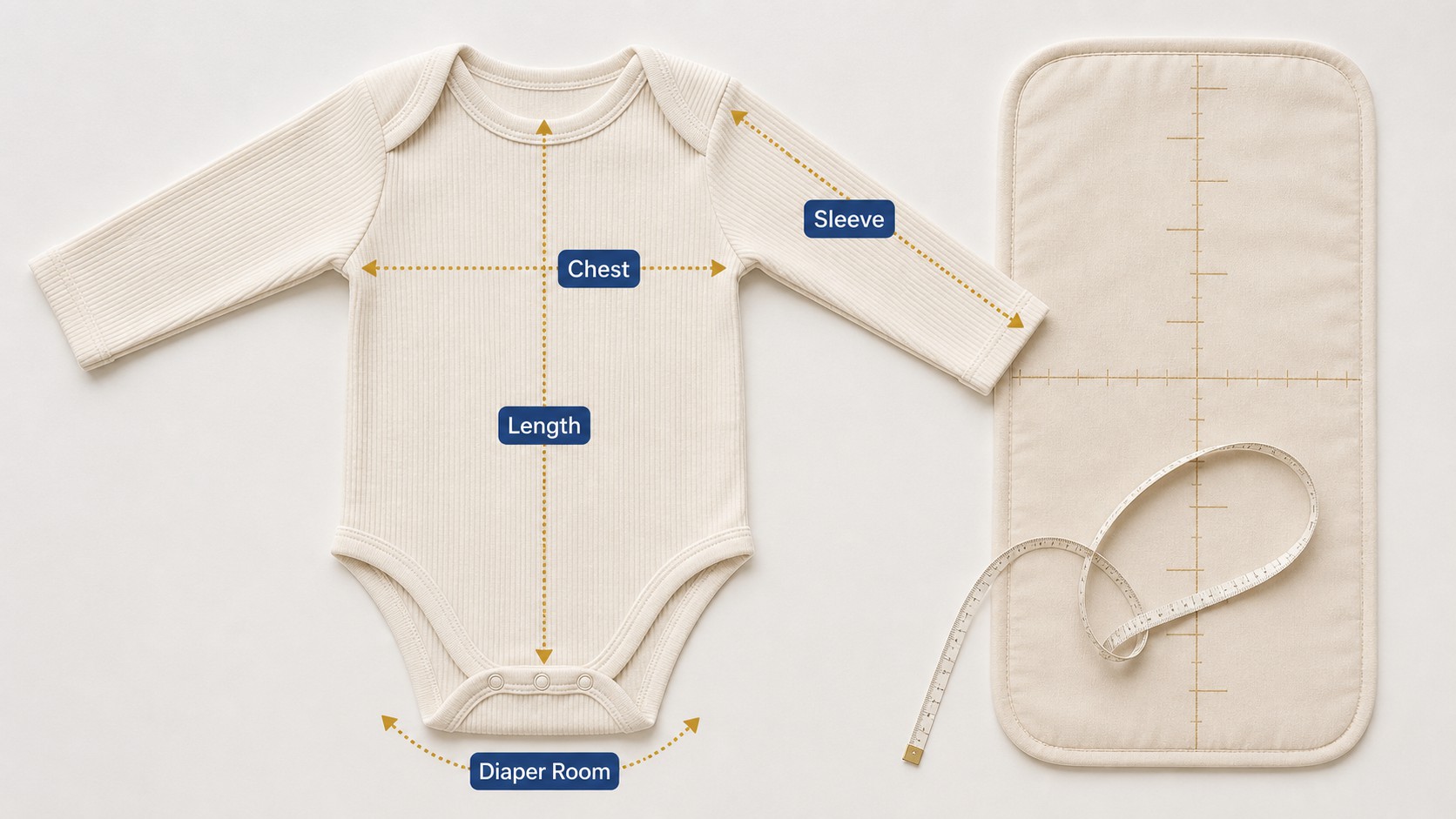
Accurate measurement is the foundation of every size decision — a 1-inch error here propagates through your entire size chart. Measure height with the baby lying flat on a firm surface, legs gently straightened, from the top of the head to the heel. Weigh the baby on an infant scale, or use the parent-minus-baby method (weigh yourself holding the baby, then subtract your own weight) and round to the nearest 0.5 lb. Measure chest circumference at the widest point of the chest, which matters most for fitted garments like bodysuits and sleepwear.
Factory Tip: During the first year, re-measure every 6-8 weeks. Infant growth spurts can shift a child from one size category to another in less than a month, and NB sizes are typically outgrown within 2-4 weeks.
Step 2: Match Measurements to the Size Chart
Once you have height, weight, and chest measurements, match them to the specific brand's size chart — never assume label equivalence across brands. Height is the primary constraint for one-piece garments (bodysuits, rompers, sleep sacks) because a garment that is too short cannot stretch to fit. Weight matters more for fitted separates and bottoms. If the child's measurements fall across two size categories (e.g., height in 6-9M range but weight in 9-12M range), use the larger size as the baseline.
Buyer Check: If you are producing custom baby apparel, build your own size chart from measurement data, not by copying a competitor's label. Your fabric, your pattern block, and your shrinkage behavior are unique to your production.
Step 3: Account for Fabric Shrinkage and Stretch
Fabric behavior changes the effective size of a garment after the first wash, so your pattern must compensate before cutting. Cotton and organic cotton fabrics shrink 3-5% after washing and drying — cold wash and low-heat drying minimize this, but most parents use standard wash cycles. High-stretch knit fabrics (rib knits, French terry with elastane) accommodate more weight variation and resist permanent distortion. Woven fabrics have minimal stretch and require more precise sizing.
Rule of Thumb: For cotton garments, add 3-5% to your pattern dimensions as a shrinkage allowance. For stretch knits, you can reduce the grading margin because the fabric itself absorbs measurement variation.
Step 4: Factor in Diaper Bulk and Brand Variations
Diaper thickness adds 1-2 inches to a baby's hip and waist measurements, which is why all infant sizes through 24M include extra hip room. If your brand targets cloth-diaper users, add even more — cloth diapers are significantly thicker than disposables. Brand body-block variations also matter: some brands cut narrow and long, others cut wide and short. When building a size chart for a new brand, decide your fit philosophy (slim, standard, relaxed) and grade consistently across all sizes.
Step 5: Size Up When Between Sizes
When a child's measurements fall between two sizes, always choose the larger size. This is the single most reliable sizing rule for baby apparel, and it works for three reasons: cotton shrinks after washing, babies grow quickly (so a slightly large garment will fit soon), and the cost of a too-small garment (a return) is higher than the cost of a slightly large one (the parent rolls up the sleeves). This rule does not apply to regulatory tight-fit sleepwear, which must fit snugly by safety standard — for those styles, follow the exact size chart.
Step 6: Build Your Custom Size Chart
For custom apparel brands, the final step is translating all of the above into a production-ready size chart. Your chart should include: size label, height range, weight range, chest circumference, and (for bottoms) waist and hip measurements. Specify your shrinkage allowance, your fit philosophy, and your grading increments. Send this chart to your factory as part of your tech pack — it is a production specification, not a marketing reference.
Baby Clothing Size Charts
Detailed size charts are the most-requested resource in baby apparel sourcing, so we provide the full reference tables here. These charts are starting points — always confirm against your brand's own pattern block and your factory's grading specifications.
US Standard Baby Size Chart (With Waist and Inseam)
| Size | Height (in) | Weight (lbs) | Waist (in) | Inseam (in) |
|---|---|---|---|---|
| Preemie (≤7 lb) | ≤20.5 | ≤7 | 16.125 | — |
| 0–3M | 20.5–24 | 7–14 | 16.125–17.375 | — |
| 3–6M | 24–27 | 14–18 | 17.375–18.5 | — |
| 6–9M | 27–29 | 18–22 | 18.5–19 | 10–11.25 |
| 9–12M | 29–30.5 | 22–26 | 19–19.5 | 11.25–12 |
| 12–18M | 30.5–32 | 26–28 | 19.5–20.25 | 12–13.5 |
| 18–24M | 32–33.5 | 28–30 | 20.25–20.5 | 13.5–14 |
| 2T | 33.5–35 | 30–32 | 20.5–21 | 14–14.75 |
| 3T | 35–38 | 32–35 | 21–21.5 | 14.75–15.5 |
| 4T | 38–41 | 35–39 | 21.5–22 | 15.5–17 |
| 5T | 41–44 | 39–45 | 22–22.5 | 17–18.75 |
EU Baby Size Chart (Height-Based)
EU baby sizes are labeled by the maximum height in centimeters the garment is designed to fit. The number on the label is the height — not the age. This system is simpler than the US system because it directly references the primary measurement, but it requires parents to know their child's current height in centimeters.
| EU Size (cm) | US Equivalent | Weight (lbs) | Height (in) |
|---|---|---|---|
| 50–56 | Preemie–NB | 5–8 | 17–22 |
| 56–62 | 0–3M | 8–12 | 22–24 |
| 62–68 | 3–6M | 12–16 | 24–27 |
| 68–74 | 6–9M | 16–19 | 27–29 |
| 74–80 | 9–12M | 19–22 | 29–30 |
| 80–86 | 12–18M | 22–26 | 30–32 |
| 86–92 | 18–24M | 26–30 | 32–34 |
| 92–98 | 2T | 29–32 | 33.5–35 |
| 98–104 | 3T | 32–35 | 35–38 |
| 104–110 | 4T | 35–39 | 38–41 |
| 110–116 | 5T | 39–43 | 41–44 |
Sleep Sack and Wearable Blanket Sizing
Sleep sacks and wearable blankets use their own sizing system based on weight and length rather than age, because fit safety depends on the neck and armhole openings being correctly sized to prevent head slippage.
| Size | Weight (lbs) | Height (in) |
|---|---|---|
| S (0–6M) | 10–18 | 23–26 |
| M (6–12M) | 16–24 | 26–30 |
| L (12–18M) | 24–30 | 30–35 |
| XL (18–24M) | 26–36 | 35–40 |
Size Label Decoder
| Label | Meaning |
|---|---|
| Preemie | Premature baby sizes, for babies under 5 lbs |
| NB | Newborn, typically 0-1 month, 5-8 lbs |
| 0-3M / 3-6M / 6-9M / 9-12M / 12-18M / 18-24M | Month-based infant sizes |
| 2T / 3T / 4T / 5T | Toddler sizes with diaper allowance in the body block |
| 6Y / 8Y / 10Y / 12Y | Big-kid sizes labeled by age, still requiring height/weight confirmation |
How Fabric Affects Baby Clothing Sizing
Fabric choice determines how a baby garment fits after production, after washing, and over months of wear — it is not a secondary consideration. Three fabric behaviors directly affect sizing outcomes: shrinkage, stretch, and regulatory fit requirements.
Cotton and Organic Cotton Shrinkage
Cotton and organic cotton fabrics shrink 3-5% after the first wash and dry cycle, with the highest shrinkage occurring in hot water and high-heat machine drying. Cold-water gentle washing and low-heat drying or line drying can reduce shrinkage to 1-2%, but most parents use standard wash cycles. For custom apparel production, this means your pattern must include a shrinkage allowance — cut the garment 3-5% larger than the finished measurement target so that the post-wash size matches your size chart. Cotton knits also lose some elastic recovery over time, so garments that start snug will relax with extended wear.
High-Stretch Knit Fabrics
High-stretch knit fabrics — rib knits, French terry with elastane, interlock with spandex — accommodate more weight variation than woven cotton because the fabric itself stretches to fit a range of body sizes. This means a single size in a stretch-knit garment can fit a wider weight range than the same size in a woven garment. For custom apparel brands, stretch knits reduce the risk of returns due to sizing variation between babies of the same age, but they require accurate GSM (grams per square meter) specification in your tech pack to ensure consistent stretch behavior across production runs.
Sleepwear Tight-Fit Regulation
Baby sleepwear sold in the US without chemical flame retardants must meet the Consumer Product Safety Commission (CPSC) tight-fit standard — the garment must fit snugly enough to reduce fire risk. This means regulatory sleepwear is intentionally cut smaller than standard sleep-and-play garments. When sizing tight-fit sleepwear, parents may need to size up for comfort, but the garment must still meet the snug-fit requirement to be compliant. For custom apparel brands producing sleepwear, this regulation directly affects your pattern grading — your sleepwear size chart cannot simply mirror your bodysuit size chart.
Common Baby Clothing Sizing Mistakes
These are the six sizing mistakes we see most often from brands producing custom baby apparel. Each one leads to returns, rework, or customer complaints — and each one is avoidable.
1. Stocking Too Many NB Sizes
Newborn (NB) sizes are outgrown within 2-4 weeks for most babies, and larger newborns skip NB entirely. Brands that stock equal quantities across all infant sizes end up with dead NB inventory. Order NB sizes in small quantities and make 0-3M your primary infant size — most babies wear 0-3M for 8-12 weeks.
2. Choosing Size by Age Alone
Age is the least reliable sizing reference for baby apparel because babies of the same month-age can vary by 3-4 inches in height and 3-5 lbs in weight. Always size by height and weight first, using age only as a secondary reference. This is why size charts list all three — the age column is for orientation, not for selection.
3. Ignoring Shrinkage in Cotton Garments
Cotton shrinks 3-5% after washing, and brands that cut to finished measurements without a shrinkage allowance produce garments that are too small after the first wash. Build shrinkage allowance into your pattern from the start — it is far cheaper than remaking a production run.
4. Forgetting Diaper Thickness
Bottom garments, bodysuits, and one-piece suits must include extra hip and waist room to accommodate diaper thickness. Disposable diapers add 1-2 inches; cloth diapers add 2-3 inches. Brands that grade bottoms to the same waist measurements as tops produce garments that are too tight in the diaper area.
5. Over-Buying Ahead by More Than One Season
Buying sizes 6+ months ahead is risky because seasonal changes and growth patterns are unpredictable — a size 12M winter coat bought in spring may not fit by winter. For custom apparel brands, this means your pre-season size run planning should account for the child's projected age and size at the time of wear, not at the time of purchase.
6. Assuming Size Equivalence Across Brands
A 6-9M label in one brand can fit differently than 6-9M in another because body blocks, fabric choices, and fit philosophies vary. Brands that copy a competitor's size label without building their own chart produce garments that don't match customer expectations. Build your own size chart from measurement data and publish it on your product pages.
How SuhuCustom Helps With Baby Apparel Sizing
SuhuCustom is a source apparel factory based in Humen, Dongguan, China, providing OEM/ODM custom apparel manufacturing including baby clothing, bodysuits, rompers, sleepwear, knitted hats, and socks. For baby apparel brands, SuhuCustom supports sizing accuracy at every production stage.
Sample development (usually 3-7 days): Before committing to a bulk size run, produce samples in each size to verify fit on real measurements. Sample development lets you catch grading errors, shrinkage issues, and pattern problems before they affect a full production run.
Pattern adjustment and size chart development: SuhuCustom can adjust patterns to your specifications and help develop a size chart that accounts for your fabric choice, shrinkage behavior, and fit philosophy. Send your tech pack with your size chart, fabric specs, and decoration details for the most accurate quote and sample.
Fabric quality checks and shrinkage testing: Fabric behavior directly affects sizing outcomes. SuhuCustom performs fabric quality checks and shrinkage control during production to ensure that the finished garment matches your size chart after washing.
Flexible MOQ for size-run trials: Testing a full size run (NB through 24M, or 2T through 5T) before committing to bulk quantities helps you identify which sizes sell and which sizes sit. SuhuCustom supports small-batch trial orders for size-run validation.
One-to-one export follow-up: Every order gets a dedicated export specialist who tracks production, QC, and shipment — so sizing issues caught during pre-shipment inspection are flagged before the order leaves the factory.
To start a baby apparel project with SuhuCustom, send your tech pack (including your size chart, fabric preferences, and logo/decoration specs) and request a free quote. Sample development usually takes 3-7 days, depending on product complexity and fabric availability.
Baby Clothing Sizing Buyer Checklist
Use this checklist before finalizing your baby apparel size chart and placing a production order.
Height is the primary sizing constraint for one-piece garments (bodysuits, rompers, sleepwear)
Weight is the secondary constraint and the primary constraint for fitted separates
Size chart includes height range, weight range, and chest circumference for each size
Shrinkage allowance (3-5%) is built into the pattern for cotton garments
Diaper allowance (1-2 inches at hip/waist) is included for all sizes through 24M
Sleepwear tight-fit sizing is separated from standard sleep-and-play sizing if applicable
Size chart is published on product pages so parents can size by measurement
NB sizes are ordered in smaller quantities than 0-3M sizes
Samples are produced in every size before bulk production begins
QC checks include measurement verification against the size chart before shipment
Final CTA
Building a baby apparel line that fits right the first time starts with a size chart that reflects real measurements, real fabric behavior, and real production tolerances — not assumptions copied from another brand's label. If you are producing custom baby clothing and need help with sizing, sampling, pattern adjustment, or size chart development, SuhuCustom can support you from tech pack to bulk shipment with factory-direct pricing, flexible MOQ, and one-to-one export follow-up.
Send your tech pack, size chart, and fabric preferences today and get a free quote. Start Your Free Quote.